Though formed in 2007, LA-based music collective Odd Future began to gain notoriety in 2009 with the release of Bastard, the first official mixtape released by de facto leader Tyler, The Creator.
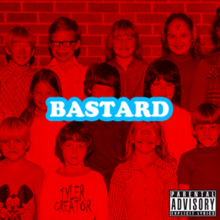
The cover, emblasoned with the tape’s title in Cooper Black font, offered very little other than the title itself and some potentially unsettling imagery haphazardly photoshopped onto an elementary school photo. Immediately, the groups use of typography on their artwork was evident and provided a sense of cohesiveness across the discographies of the collective as well as members’ own solo projects.
Notable members of the Odd Future collective, which disbanded in the mid 2010s, include Tyler, Earl Sweatshirt and Frank Ocean – all of whom have become critically lauded in their own individual lanes in the hip hop and R&B scenes. Though some may consider Frank Ocean to be the most successful of the three after his progressive R&B magnum opus Blonde was released in 2016, Tyler has released 3 critically acclaimed projects since 2016 whereas Frank has not released any real projects in this time.
Tyler, The Creator is generally considered to have been on a creative streak since his 2017 album Flower Boy, where he began to talk more personally about his emotions rather than the potentially shocking subject matters tackled on his earlier projects.
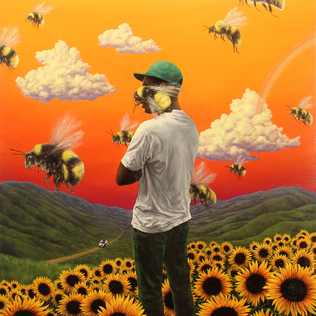
The general perception of him as an artist shifted from an edgy, shock-value type rapper to somewhat of an auteur. Though he had always produced the majority of his music himself, on this project Tyler drew from different influences like neo-soul, R&B and even krautrock through a sample of legendary German prog band Can. Flower Boy, notably, was his first project to not include any form of writing, handwritten or in the form of a font. This could be an indicator of Tyler growing into himself more and becoming more confident in the projects he would release from this point onwards, choosing to only give his audience the music itself and the artwork he had commissioned for the project.
In his two projects since then, both of which have won ‘Best Rap Album of the Year’ at multiple awards shows including the Grammys, Tyler has chosen to use minimal written information on the covers.
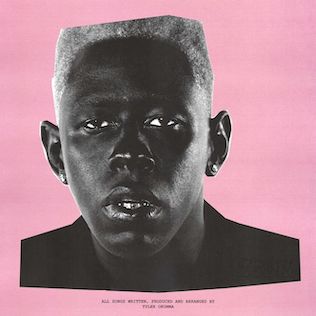
On the cover for Igor (2019), the only written information is ‘all songs written, produced, and arranged by Tyler Okonma’ in a low contrast, serif font with a low weight, imitating the style of a typewriter. Tyler doesn’t even need to place his globally recognised moniker on the cover, choosing instead to flex his creative chops on his own Grammy winning album by crediting his lesser known real name.
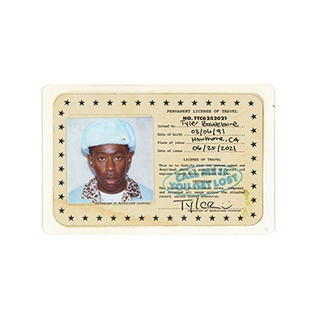
The 2021 album Call Me if You Get Lost includes a passport of some kind on the cover, with the only writing being handwritten other than the obscured writing printed on the passport, i.e. ‘Place of Birth’ etc. This album does include the title of the album in the form of a stamp on the passport, in a heavy-weight, sans serif font with low contrast that bends to fit the shape of the elongated circle shape of the stamp. Again, Tyler chooses to credit himself not by his creative alias but by a pseudonym he uses throughout the project; something he has done throughout his discography.
It’s clear that Tyler has grown to appreciate different aspects of cover art in the years since his earlier projects. The original covers for Wolf (2013) and Cherry Bomb (2015) included noticeable uses of the titles on the covers.
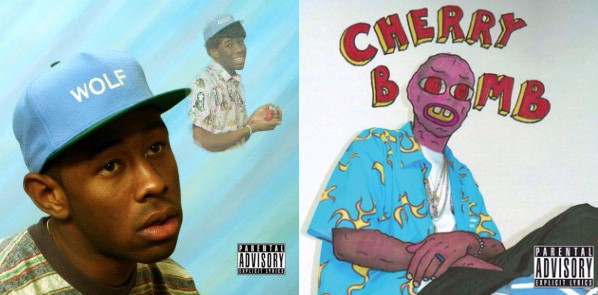
However, in recent months, Tyler has decided to change the covers on streaming platforms to alternate covers that were included in some physical copies of the albums upon their release.
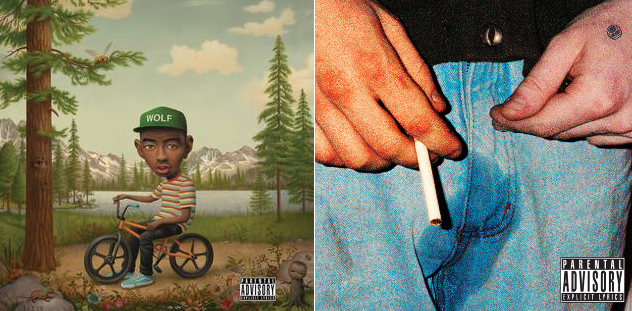
The lack of typography in Tyler’s discography from 2013 onwards, when viewed on streaming services, could show how his taste in cover art has changed over the years as his profile has steadily risen and opens up the discussion of whether choices of font and other aspects of cover art typography are required in the age of streaming. People seek out artists they enjoy and can discover a near-infinite amount of music with a near-infinite amount of information on said music, potentially making the need for information on covers unnecessary. The death of crate digging is here for the majority of the world and cover artists have taken note.